
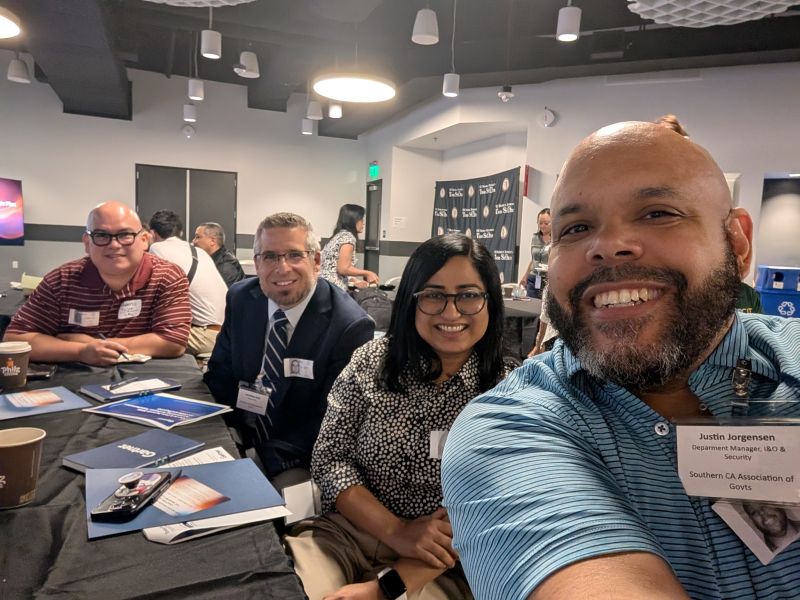
I spent a day at Gartner's OC AI & Data Summit recently, mostly with other local government folks, and one exercise from that day is still stuck in my head. Brian Foster was leading it. Before you start a project, he said, write the press release announcing its success. Write it like the project is already done and it worked.
He came back to that idea a few times during the day, worded a little differently each round. And the exercise works, because when you sit down to actually write that fake press release, you find out fast whether you know what you're doing. What changed? Who benefited? What problem got solved? If you can't answer those in plain language, you're holding a technology in search of a reason.
That was the thread running through the whole day, at least the way I heard it. Brian kept pulling us back to the executive view. Start with the business need, then go find the tools that serve it. Most of us in IT have watched the reverse happen more times than we'd like to admit. Somebody falls in love with a platform, the org buys it, and then everyone spends two years trying to find problems worthy of the solution. The tail wags the dog.
The tabletop discussions ran the same direction. We worked through a strategy-on-a-page template, mapping AI use cases to actual business goals, and the honest moment at every table was the same. Everybody has AI ideas. The hard part was tying any of them to a goal the organization already cares about. A lot of ideas didn't survive it.
I'd heard the same thing a few days earlier
A few days before the summit, I'd listened to a podcast about forward deployed engineers, the FDE role that Palantir made famous and that half of tech is now scrambling to hire for. Different world entirely. These are people getting paid very well to embed inside companies and figure out where AI actually belongs in the business.
So while Brian was talking, I kept connecting the dots back to that episode. The argument was nearly identical.
The reasoning goes like this. Every company can now buy intelligence. The frontier models are available to anyone with a credit card, and your competitor is using the same ones you are. So intelligence itself stopped being an advantage. The advantage moved to deployment: knowing where to apply it, how, and why, inside one specific organization with all its quirks.
The part that got me was how an FDE starts an engagement. Before anything gets built, they go sit with the people doing the work. Sometimes for full days, watching the job happen, because the documented process is almost never the real process. "An email arrives" sounds like a clean trigger until you learn it arrives from forty different senders, half the data is buried in screenshots and forwarded threads, and the routing logic lives entirely in one person's head. Nobody writes that down. You only get it by sitting there when the weird one comes in.
Only after all that watching does the FDE make the call that matters: where does AI belong in this workflow, and where does it not? Maybe three steps out of ten need real judgment and the rest is ordinary deterministic software. Maybe the whole workflow should be left alone because the risk outweighs the payoff. That MIT stat about 95% of generative AI pilots failing gets quoted everywhere, and I'd bet most of those failures trace back to skipping this step. Somebody bolted AI onto a process nobody had bothered to understand first.
Sound familiar? It's Brian's press release exercise wearing an engineer's badge. The audit is just a rigorous way of gathering the material you'd need to write that press release honestly.
What this looks like from a local government seat
I run infrastructure for a local government organization, and this matters more here than almost anywhere. We don't get venture money to burn on experiments. Every dollar is public money, every failed pilot is a story someone gets to tell at a board meeting, and our workflows have decades of exceptions baked into them. The person who knows why the process skips step four when a certain vendor is involved has usually been here fifteen years, and none of it is in the SOP.
So before I champion any AI initiative, I'm stealing both halves of this. Write the press release first. If I can't describe the successful outcome in three sentences a department manager would care about, the project isn't ready. Then do the FDE work: sit with the people who own the workflow, map how it really runs, and be willing to conclude that AI doesn't belong there at all. That last part takes more discipline than the first two. Nobody hands out conference talks for the pilot you decided not to run.
One more thing about the summit, because it was the part I'd have missed most if I'd skipped the trip. The sessions were good. The tabletop conversations were better. There's something about comparing notes with people who have your same constraints, your same procurement rules, your same fifteen-year-old ERP, that no vendor briefing can touch. Half my notes from the day came from those conversations, and a few of them turned into the kind of contacts you end up calling six months later when you're stuck.
I don't know yet which of our workflows will survive the press release test. That's sort of the fun part. I've got a shortlist and a template, and the first draft of the first press release is due, to myself, by end of month. I'll debrief here on how it goes, including the ones that die on the page. Especially those.
The day wrapped up at a happy hour at Chapter One: The Modern Local in Santa Ana, the second year in a row we've closed out the summit there. Credit to Kia Marie Savidis, who put the whole event together. Really good conversations there too, and not only about AI. We drifted into cryptocurrency for a stretch, which was a nice change of pace. I posted a shorter day-of recap over on LinkedIn.